Every guest asks reception the same questions. Now the answers are on their own phone, in their own language.
A resort runs like a small town: restaurants with different hours, pools, a beach, a spa, a kids' club, an evening show and a shuttle into town, with guests arriving from many countries every day. They all want to know the same things: when breakfast ends, which restaurant needs a booking, where to get a towel, what time the shuttle leaves. Today those answers sit in a welcome folder, on a board in the lobby and at a reception desk with a queue. ToRun's AI assistant puts them on each guest's own phone.
Available now. Try it on your phone with your own hotel's information. Last reviewed: November 2026
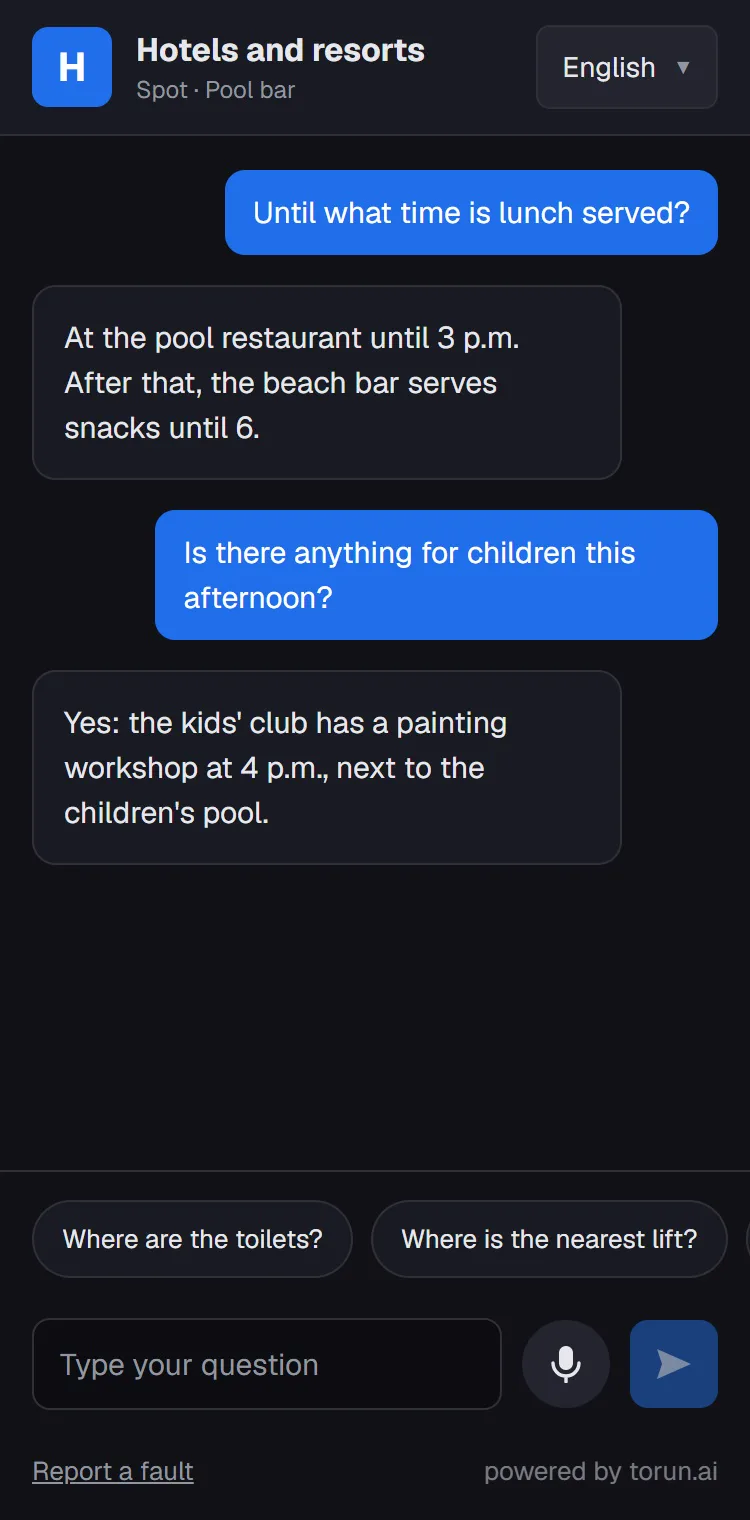
Spot · Pool bar
Until what time is lunch served?
At the pool restaurant until 3 p.m. After that, the beach bar serves snacks until 6.
Is there anything for children this afternoon?
Yes: the kids' club has a painting workshop at 4 p.m., next to the children's pool.
Why a hotel is one of the best places for it
The same questions, all day
Breakfast hours, the Wi-Fi, the shuttle, late check-out. Most questions at the desk have been asked many times before, and each one takes a member of staff away from a guest who needs a person.
Guests from everywhere
A resort hears many languages in a single day. The guest asks in their own, and the answer comes back in it, even when your documents are written in another.
A programme that changes every day
Activity times, the evening show, a restaurant closed for a private event. A printed programme is soon out of date; when the document is updated, the answer changes with it.
A large site
Blocks, pools, a beach and a spa spread across the grounds. With a code at each spot, the answer starts from where the guest is standing.
A question from the lobby, the beach or the spa
The code in the lobby and the code at the beach are different codes, so the assistant knows where the guest is standing. The answers come from the fact sheet, restaurant hours, activity programme and service information the hotel uploads.
Illustrative examples. Answers are generated from the information the venue uploads; when the documents have no answer, the assistant says so and the question goes to the report.
Four sides of the hotel, four different gains
The same setup gives each part of the hotel something different: the guest gets an answer without queuing, reception gets time back, the technical team hears about a fault from the guest who saw it, and management plans the next season on what guests actually asked.
Gets an answer without a queue
At any hour, from the room, the pool or the beach, in their own language, typed or spoken. The page asks for no name and no room number.
Spends its time on the guests who need a person
Questions about hours, places and services are answered where they come up. The desk keeps what only people can do: check-in, a complaint, a special request.
Hears about a fault from the guest who saw it
“The lights on the path to the beach are out” or “the lift in block B has stopped” reaches the panel with its spot and time, and by e-mail. If nobody picks it up within the set time, it moves up to the next person in charge.
Plans the next season on what guests asked
What guests asked for and the hotel does not offer is collected in its own list: a late-night snack, a vegan menu, a shuttle to the old town. Measured demand for a new service, not a guess.
In the places where guests actually ask
A print-ready poster comes out of the system for each spot; the codes can also be printed on existing signs and directory boards.
At the end of the season, you know what your guests were looking for
The report is made of questions: what was asked, at which spot, when, in which language, and whether it was found.
Most-asked topics
Asked for, not offered
Questions per hour, an average day
Busiest spot: the pool bar · Busiest hour: 11:00–12:00Languages of the questions
English 31% · German 24% · Russian 15% · Arabic 9% · Dutch 7% · Other 14%Illustrative report. The real figures come from your own visitors' questions.
New services and packages
The asked-for-but-not-offered list is measured demand: the late-night menu, the excursion, the transfer guests keep asking about. It downloads as Excel or CSV.
Staff and shifts
The spread across hours and spots shows where guest relations staff are needed, and when.
Marketing by language
The languages of the questions are a sign of which markets your guests come from, and of which language your welcome material needs next.
How it fits the season
- Before the seasonYou upload the fact sheet, restaurant and bar hours, the activity and entertainment programme, spa and kids' club rules, transfers and house rules, as Word, PDF, Excel or PowerPoint; no special format. You pick the spots and print a poster for each. The page goes live with the hotel's name, logo and colour, and the people you choose get panel access.
- During the seasonGuests scan, ask and read. When the programme or a restaurant's hours change, the document is updated and the answers follow. Fault reports reach the panel and e-mail straight away, and the day's questions and the not-offered list can be followed in the panel.
- Between seasonsThe demand report is in the panel, and the asked-for-but-not-offered list downloads as Excel or CSV: input for next season's services, menus and staffing. The spots and codes stay where they are; what changes is the content you upload.
Hotels and resorts
Priced by room count, billed only for the months you are open.€5 per room, per open month
See all venue pricesThree principles
No paid answers
No tenant or exhibitor can pay to be put first; the order of an answer cannot be bought.
It doesn't make things up
The assistant is set up to answer only from the venue's own documents and website. When there is no answer, it says so, and the question goes to the asked-but-not-found list.
No identity required
No account, no form, no name or phone number. The visitor scans the code and asks.
We collect questions, not people
The record is made of the question: what was asked, at which spot, when, in which language, and whether an answer was found. The venue sees what its visitors are looking for without knowing who they are.
Minimal data
Visitors are never asked for an account, a name, a phone number, an e-mail address or an ID number. The page asks for neither location nor camera permission.
Recordings are not kept
A spoken question is turned into text, and the recording is not stored.
No profiles
Question records contain no identity, IP address or device information, and no tracking cookies are used. The browser holds a temporary session key that keeps that visit's conversation going and is deleted when the tab closes; only if a venue turns on its optional daily question limit per device does it also keep a random key for 24 hours, used for that limit alone.
Your data stays yours
Only the people you authorise can see it. It is not sold and not used for marketing.
Roles set by contract
The venue is the data controller and ToRun is the data processor. Our Data Processing Agreement is published.
Read the Data Processing AgreementHosted in the EU
Hosting is in the European Union (Germany). When the contract ends, data is returned or deleted as you choose; the sub-processors are listed in the agreement.
Protected against misuse
Automatic bot verification and a per-visit question limit; answers and fault reports pass automatic content checks.
Frequently asked
Does it ask guests for their room number?
No. The page asks for no name, room number or phone number, and the assistant is set up never to ask for one. If a guest writes their room number anyway, the assistant does not repeat it or use it.
Can guests book a table or a spa treatment through it?
No. It is not connected to your booking systems. It tells guests how and where to book, from your documents, and the booking itself stays with your team.
Do we need to translate our documents?
No. You upload your documents in the language you work in; someone who asks in another language gets the answer in theirs.
What about the Wi-Fi?
The hotel's Wi-Fi or the guest's mobile connection is enough, and the network name can be printed next to the code. The page is light and opens quickly on a weak connection.
What happens when the answer is not in our documents?
The assistant says it does not have that information instead of guessing, and the question goes to the asked-but-not-found list in your panel. That list shows which information is missing, and it downloads as Excel or CSV.
What does a venue need to provide to start?
Mostly documents you already have: store, unit or exhibitor lists, floor details, opening hours, services and rules, as Word, PDF, Excel or PowerPoint. You pick the spots, and a print-ready poster with its own QR code comes out of the system for each one.
We run more than one venue.
Each venue is set up with its own content, codes and reports, all managed from one account. Head office writes once and the venues below it answer from the same information; each manager sees only their own venue.
Can we get a surprise bill?
No. The number of questions is set in the contract and usage is visible in the panel at any time; when the number runs out, no extra charge is made without your approval.
Is the AI trained on our data?
No. The AI is not trained on your data; the documents are read at the moment a question is asked. That is why an update to a document shows up in the answers.
Let's set it up at your hotel
We start with a short setup on a limited number of spots, together with your team: we handle the setup and configuration, you provide the documents, and at the end we read the report of what guests were looking for together. Scope, duration and terms are agreed in a meeting.
Before we meet: we can build a trial page from the public information on your hotel's website, so you can try the assistant on your own phone with your own hotel's information.