Nobody wants to get lost in a hospital. Now the way, the hours and the rules are on their own phone.
A hospital is a building people visit when they would rather not: clinics on different floors, a laboratory, radiology, registration, visiting hours, rules for companions, the car park. Patients and visitors ask the same questions at every desk and in every corridor, often in a language the staff do not speak. Today the answers sit on signs, at a busy information desk and with staff who have patients waiting. ToRun's AI assistant brings them to the visitor's own phone, starting from the spot where they are standing.
Available now. Try it on your phone with your own hospital's information. Last reviewed: November 2026
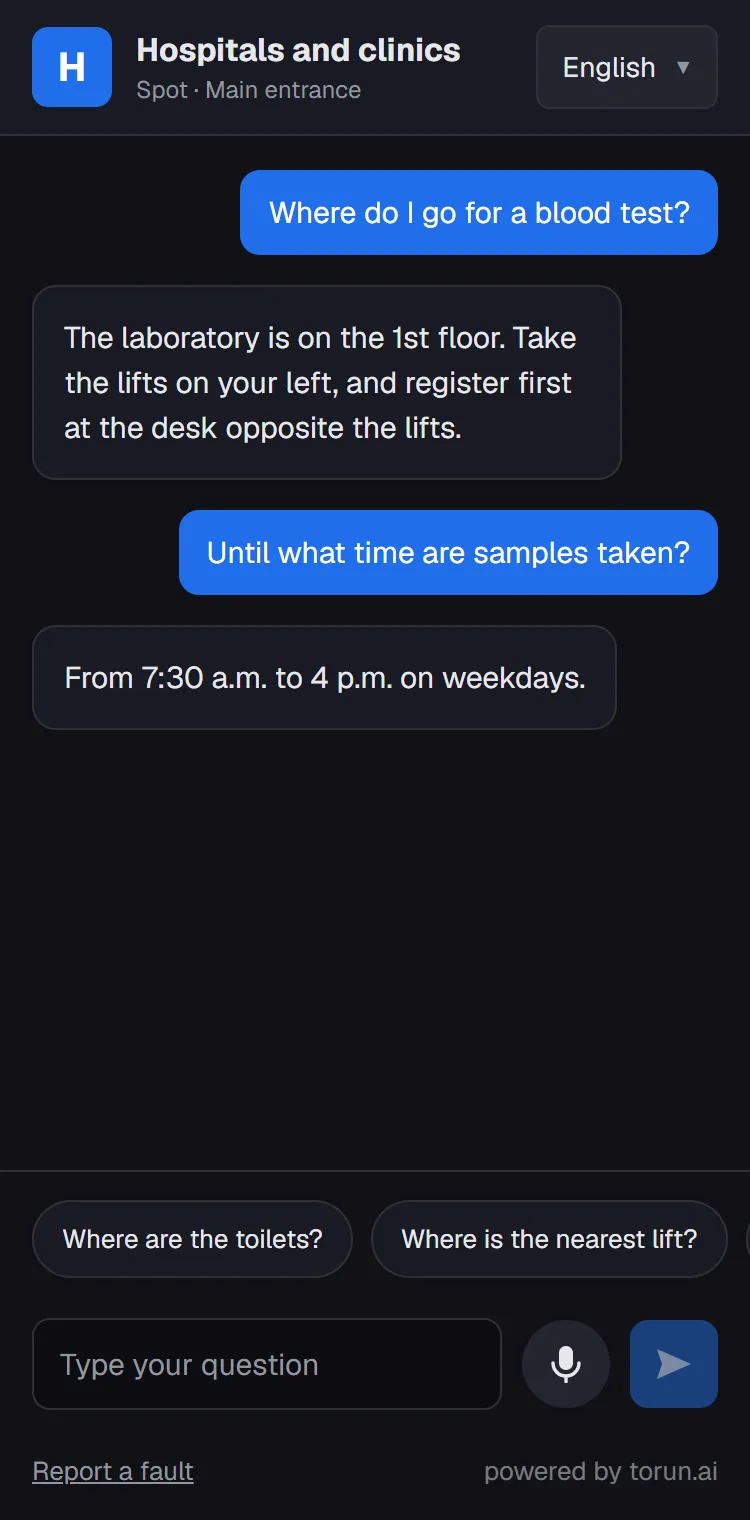
Spot · Main entrance
Where do I go for a blood test?
The laboratory is on the 1st floor. Take the lifts on your left, and register first at the desk opposite the lifts.
Until what time are samples taken?
From 7:30 a.m. to 4 p.m. on weekdays.
Why a hospital needs it more than most buildings
A building nobody knows
Most patients come only a few times a year. Floors, wings and clinic names are new to them every time, and a sign cannot answer a question.
Their own language, at any age
Patients from abroad, visitors from out of town, elderly companions. They can type or speak, and the answer comes back in the language of the question.
Staff time belongs to patients
Every “where is radiology?” at the nurses' station is time taken from care. Questions like that are answered at the spot where they come up.
Rules that change
Visiting hours, companion rules, parking, a clinic that moved floors. When the document is updated, the answer changes with it; a printed sign stays as it is.
From the car park to the clinic door
The code at the main entrance and the code in the car park are different codes, so the assistant knows where the person is standing. The answers come from the clinic list, floor information, visiting rules and service information the hospital uploads.
Illustrative examples. Answers are generated from the information the venue uploads; when the documents have no answer, the assistant says so and the question goes to the report.
Four sides of the hospital, four different gains
The same setup gives each side something different: the patient finds the way, the information desk gets time back, the technical team hears about a fault from the person who saw it, and management sees where people get lost.
Find the way without asking three times
Directions from the spot where they stand, the hours and the rules, in their own language, typed or spoken. No account, no name, no patient number.
Spend their time on the people who need a person
Floors, clinics, hours and rules are answered at the spot. The desk keeps what only people can do: reassuring someone, an exception, a patient who needs to be accompanied.
Hear about a fault from the person who saw it
“The lift in block C has stopped” or “the accessible toilet on the 2nd floor is locked” reaches the panel with its spot and time, and by e-mail. If nobody picks it up within the set time, it moves up to the next person in charge.
Sees where people get lost
Which spots collect the most questions, at which hours and in which languages, and what people looked for and did not find. Input for signs, staffing and interpreter planning.
At every point where someone stops to ask
A print-ready poster comes out of the system for each spot; the codes can also be printed on existing signs and directory boards.
After a month, you know where people get lost
The report is made of questions: what was asked, at which spot, when, in which language, and whether it was found.
Most-asked topics
Asked for, not found
Questions per hour, an average weekday
Busiest spot: lift hall, ground floor · Busiest hour: 09:00–10:00Languages of the questions
Local language 71% · English 11% · Arabic 8% · Russian 4% · German 2% · Other 4%Illustrative report. The real figures come from your own visitors' questions.
Signs
The spots where people ask the way most are where a sign is missing or unclear, and the asked-but-not-found list says what they wanted. It downloads as Excel or CSV.
Guides and interpreters
The spread across hours, spots and languages shows where guides and interpreters are needed, and when.
Patient information
What patients and visitors ask is a record of what confused them: input for the next patient leaflet, the website and the signs.
How it fits the hospital
- Before it goes liveYou upload the clinic list, floor and wing information, visiting and companion rules, parking and services, as Word, PDF, Excel or PowerPoint; no special format. Your staff mark the spots and places on the floor plan, and a print-ready poster comes out for each spot. The page goes live with the hospital's name, logo and colour.
- Every dayPatients and visitors scan, ask and read. When a clinic moves or visiting hours change, the document is updated and the answers follow. Fault reports reach the panel and e-mail straight away.
- Month by monthThe demand report is in the panel, and the asked-but-not-found list downloads as Excel or CSV: input for signs, staffing and patient information. The spots and codes stay where they are; what changes is the content you upload.
Hospitals
Priced by bed count.From €1,000 a month
10,000 answers a month included
See all venue pricesThree principles
No paid answers
No tenant or exhibitor can pay to be put first; the order of an answer cannot be bought.
It doesn't make things up
The assistant is set up to answer only from the venue's own documents and website. When there is no answer, it says so, and the question goes to the asked-but-not-found list.
No identity required
No account, no form, no name or phone number. The visitor scans the code and asks.
We collect questions, not people
The record is made of the question: what was asked, at which spot, when, in which language, and whether an answer was found. The venue sees what its visitors are looking for without knowing who they are.
Minimal data
Visitors are never asked for an account, a name, a phone number, an e-mail address or an ID number. The page asks for neither location nor camera permission.
Recordings are not kept
A spoken question is turned into text, and the recording is not stored.
No profiles
Question records contain no identity, IP address or device information, and no tracking cookies are used. The browser holds a temporary session key that keeps that visit's conversation going and is deleted when the tab closes; only if a venue turns on its optional daily question limit per device does it also keep a random key for 24 hours, used for that limit alone.
Your data stays yours
Only the people you authorise can see it. It is not sold and not used for marketing.
Roles set by contract
The venue is the data controller and ToRun is the data processor. Our Data Processing Agreement is published.
Read the Data Processing AgreementHosted in the EU
Hosting is in the European Union (Germany). When the contract ends, data is returned or deleted as you choose; the sub-processors are listed in the agreement.
Protected against misuse
Automatic bot verification and a per-visit question limit; answers and fault reports pass automatic content checks.
Frequently asked
Will it answer medical questions?
It is set up to answer questions about the building and its services from your documents. For a health question it gives general, publicly documented information and one sentence pointing to a professional; it does not diagnose or give doses.
Does it see patient records?
No. It is not connected to your hospital information system, and the page asks for no name, patient number or ID. Question records contain no identity, IP address or device information.
Do we need to translate our documents?
No. You upload your documents in the language you work in; someone who asks in another language gets the answer in theirs.
We run more than one venue.
Each venue is set up with its own content, codes and reports, all managed from one account. Head office writes once and the venues below it answer from the same information; each manager sees only their own venue.
What happens when the answer is not in our documents?
The assistant says it does not have that information instead of guessing, and the question goes to the asked-but-not-found list in your panel. That list shows which information is missing, and it downloads as Excel or CSV.
What does a venue need to provide to start?
Mostly documents you already have: store, unit or exhibitor lists, floor details, opening hours, services and rules, as Word, PDF, Excel or PowerPoint. You pick the spots, and a print-ready poster with its own QR code comes out of the system for each one.
Can visitors speak instead of typing?
Yes. They hold the microphone button and speak, up to 30 seconds per press. The spoken question is turned into text, the recording is not kept, and the answer arrives in writing.
Can we get a surprise bill?
No. The number of questions is set in the contract and usage is visible in the panel at any time; when the number runs out, no extra charge is made without your approval.
Is the AI trained on our data?
No. The AI is not trained on your data; the documents are read at the moment a question is asked. That is why an update to a document shows up in the answers.
Let's set it up at your hospital
We start with a short setup on a limited number of spots, together with your patient services team: we handle the setup and configuration, you provide the documents, and at the end we read the report of what patients and visitors were looking for together. Scope, duration and terms are agreed in a meeting.
Before we meet: we can build a trial page from the clinic and visitor information on your hospital's website, so you can try the assistant on your own phone with your own hospital's information.