At a fair, every visitor asks the same questions. Now the answers are on their own phone.
Thousands of visitors, dozens of halls and hundreds of exhibitors share the same space for a few days, and every visitor has the same questions: which hall is the company I'm looking for in, which room is the seminar in, where is the coat check, when does the shuttle leave. Today those answers sit in a thick catalog, on a board at the entrance and at a crowded information desk. ToRun's AI assistant brings them to the visitor's own phone.
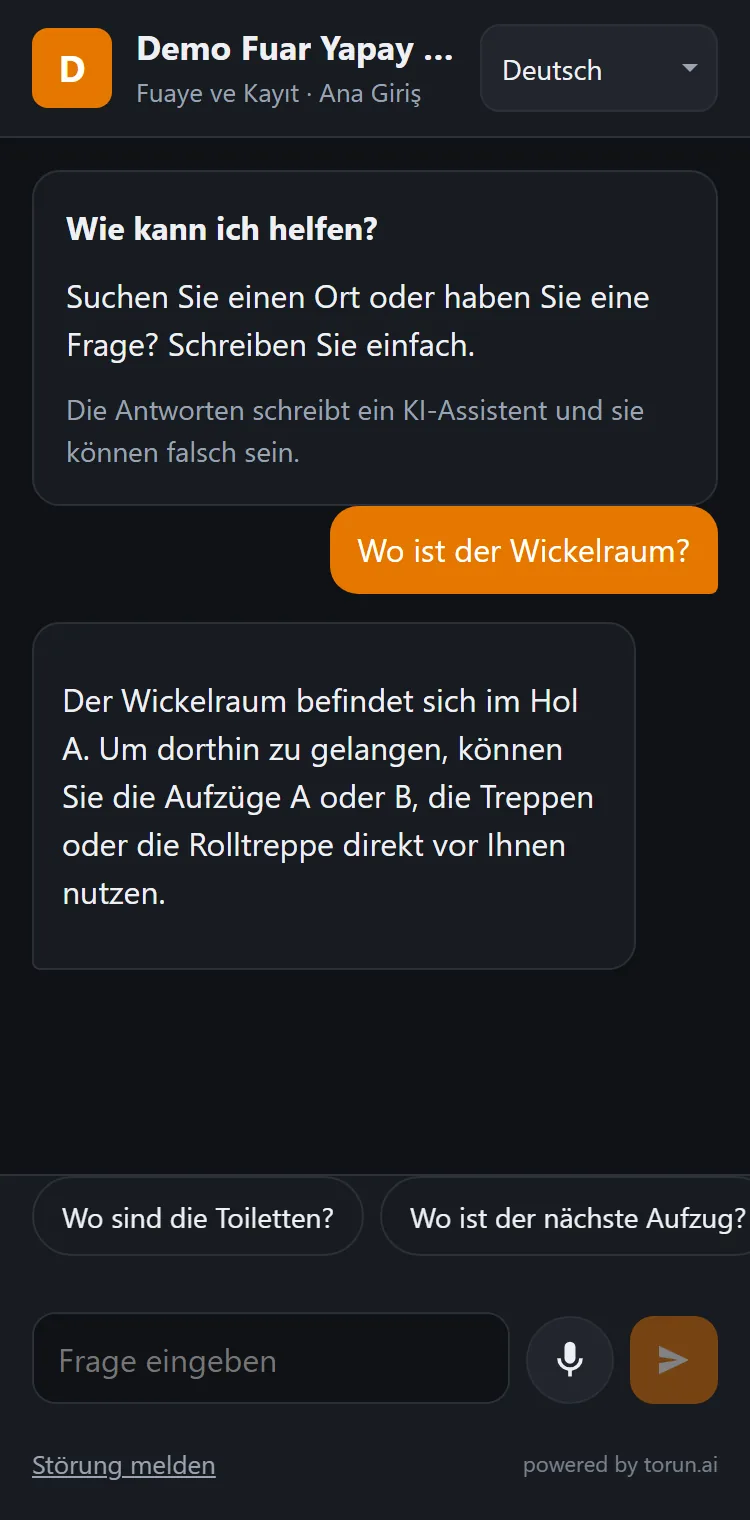
Every code knows where it hangs
The code at the entrance of Hall 3 and the code outside the conference room are different codes, so the assistant knows where the visitor is standing and gives directions from there. The answers come from the exhibitor list, hall plan, program and service information the organizer uploads.
Illustrative examples. Answers are generated from the information the fair uploads; when the documents have no answer, the assistant says so and the question goes to the report.
Four sides of the fair, four different gains
The same setup gives everyone at the fair something different: the visitor finds what they came for, the exhibitor is found, the operations team hears about problems straight away, and the sales team talks about the next fair with measured demand.
No line and no office hours; directions start from where they stand. They can search by product or sector without knowing a company's name. Program, rooms, times, shuttles and the coat check on one page, in their own language, typed or spoken.
A visitor searching by product or sector is sent to companies whose names they didn't know. When a stand moves at the last minute, visitors go to the right place as soon as the list is updated.
“The restroom in Hall 4 is closed” or “the escalator at gate B has stopped” reaches the panel with its spot and time, and by e-mail. If nobody picks it up within the set time, it moves up to the next person in charge. The halls and hours where questions pile up are visible too.
Products and sectors visitors asked for but did not find at the fair are collected in their own list. A sentence like “400 visitors asked for medical packaging, and there was one exhibitor” is an argument for the next stand sale.
Where the questions start, not at one desk
A print-ready poster comes out of the system for each spot; the codes can also be printed on existing signs and directory boards.
When the fair closes, you keep a map of what visitors were looking for
The report is made of questions: what was asked, at which spot, when, in which language, and whether it was found.
Illustrative report. The real figures come from your own visitors' questions.
The searched-for-but-not-found list is measured demand for products and sectors that are not at the fair yet. It downloads as Excel or CSV.
What is searched for in which hall, which seminar is asked about most and which hours get busy: direct input for the next fair's hall plan, room sizes and schedule.
The spread across hours and spots shows where information staff, interpreters and security are needed, and when.
How it fits the fair calendar
You upload the exhibitor list (company, stand, hall, product group, country), hall and room information, the seminar program and the services (coat check, food, parking, shuttles, Wi-Fi), as Excel, Word or PDF; no special format. You pick the spots and print a poster for each. The page goes live with the fair's name and logo, and the people you choose get panel access.
Visitors scan, ask and read. A last-minute stand or program change goes into the document and the answers follow. Fault reports reach the panel and e-mail straight away, and the day's questions and the not-found list can be followed in the panel.
The demand report is in the panel, and the not-found list downloads as Excel or CSV; the sales team builds its list of prospective exhibitors from measured demand. The spots and codes can be used again at the next fair in the same venue; what changes is the content you upload.
Three principles
No tenant or exhibitor can pay to be put first; the order of an answer cannot be bought.
The assistant is set up to answer only from the documents the venue uploads. When there is no answer, it says so, and the question goes to the asked-but-not-found list.
No account, no form, no name or phone number. The visitor scans the code and asks.
We collect questions, not people
The record is made of the question: what was asked, at which spot, when, in which language, and whether an answer was found. The venue sees what its visitors are looking for without knowing who they are.
Frequently asked
What if mobile reception in the hall is weak?
The fair's Wi-Fi is enough, and the network details can be printed next to the code. The page is very light and opens quickly on a weak connection.
Several fairs at the same time?
Each fair is set up with its own content, codes and reports, all managed from the same organizer account.
How many people can use it?
There is no limit on the number of visitors; use is planned as a monthly number of questions, sized to the fair.
Can we get a surprise bill?
No. The number of questions is set in the contract and usage is visible in the panel at any time; when the number runs out, no extra charge is made without your approval.
Let's set up the first fair together
The software is ready and live. We want to do the first fair setup together with an organizer: a setup that starts with a limited number of halls, and at the end we read the report of what visitors were looking for together. Scope, duration and terms are agreed in a meeting.
Before we meet: we can build a trial page from the public exhibitor list on your fair's website, so you can try the assistant on your own phone with your own fair's information.